
First Impressions: Open, Tap, Roll
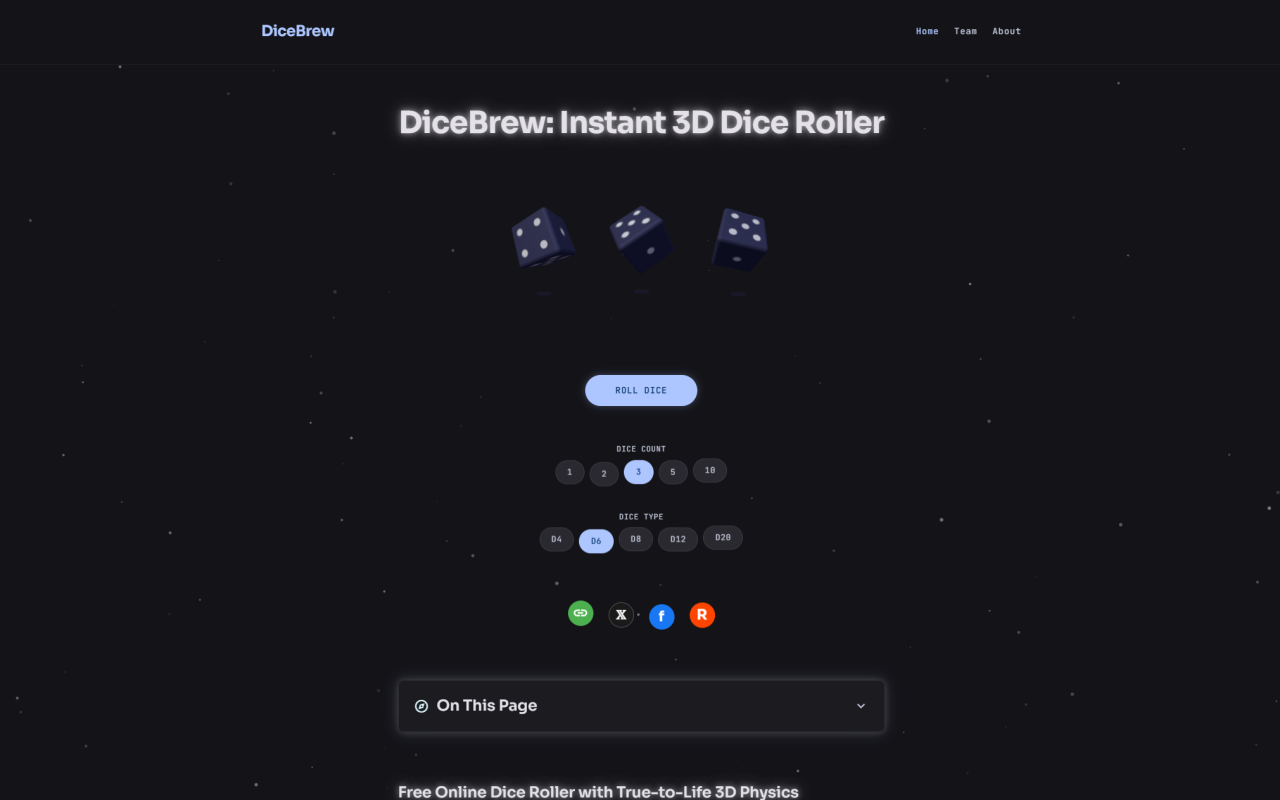
Upon visiting dicebrew.com, the first thing that strikes you is the complete absence of friction. There is no landing page selling you on features, no pop-up asking for an email address, and no tutorial forcing you through onboarding steps. The page loads directly into the dice rolling interface: a clean, dark-themed workspace with a virtual felt tray in the center, dice type and count selectors on the left, and a prominent Roll Dice button. I tested it on both a desktop browser and a mid-range Android phone. On the phone, the layout collapsed into a single-column view with large, finger-friendly buttons that felt immediately usable even during a fast-paced game turn. The tool loads in roughly one second on a standard broadband connection, and the first roll executed without any perceptible delay. This is the core proposition of 345Dice — it is a tool that gets out of your way and lets you roll dice as naturally as reaching into a physical bag.
The Physics Engine Feels Genuinely Physical
345Dice uses WebGL for real-time 3D rendering combined with a custom physics engine that simulates gravity, object collisions, and surface friction. I tested a roll of five D6 dice simultaneously. The dice tumbled over each other, bounced off the virtual tray walls, and settled into a natural scattering pattern rather than stacking or clipping through one another. Each die displays a subtle matte texture with beveled edges, and the numbering is crisp and readable from any angle. The camera angle is fixed at a slight overhead perspective, which means you see the dice as you would looking down at a real table. When I rolled a single D20, the die spun for a satisfying moment before settling — the final result appears on the face, but the animation includes enough tumble that you feel the suspense of watching a real die come to rest. The physics model is not just cosmetic: because the simulation influences the final outcome in conjunction with the random number generator, each roll feels unique rather than recycled. The animation runs at a consistent 60 frames per second on both desktop and mobile, and I noticed no frame drops even when rolling ten dice simultaneously.
Privacy Architecture and Cryptographic Fairness
The privacy model here is structural rather than performative. The entire application — including the WebGL rendering pipeline, the physics engine, and the random number generator — executes entirely within your browser. I confirmed this by opening the browser's developer tools and monitoring network activity during a series of rolls. No data packets were sent to any external server. No cookies were set. No local storage was written beyond what the browser might cache for the page assets themselves. The random number generator uses the crypto.getRandomValues() Web API, which is the same cryptographic primitive used in secure key generation and password hashing. This means the seed value for each roll is genuinely unpredictable, not seeded from system time or a pseudo-random algorithm. Combined with the physics simulation — where small variations in dice position, velocity, and rotation compound into wildly different outcomes — the result is a fairness model that satisfies both competitive players and casual users. For classroom use or tournament settings, this level of transparency is meaningful. The site also contains no analytics trackers, no advertising scripts, and no third-party embeds. Closing the tab erases your session entirely.
Supported Dice and Tabletop Use Cases
345Dice supports five polyhedral types: D4, D6, D8, D12, and D20. You can select dice quantities of 1, 2, 3, 5, or 10 using dedicated preset buttons. This covers the vast majority of tabletop RPG and board game scenarios. For Dungeons & Dragons, the D20 handles attack rolls and saving throws, the D8 covers most weapon damage, and the D4 handles spells like Magic Missile. The default 2-dice mode shows the sum of both dice immediately below the tray, which is ideal for games like Monopoly, Settlers of Catan, or Backgammon. The 5-dice and 10-dice presets align neatly with Yahtzee or Liar's Dice setups. The interface also includes a shareable URL feature: clicking the share icon generates a link that copies the exact dice configuration to your clipboard, which you can send to remote players. This is a thoughtful touch for online sessions where players use separate devices but need synchronized settings. The tool maintains its state across page refreshes within a single browser session, though closing the tab resets everything — consistent with the no-tracking philosophy.
Notable Limitations: What's Missing
While 345Dice executes its core function well, there are significant feature gaps worth noting. The most obvious omission is the absence of a D10 and D100. For World of Darkness, Call of Cthulhu (which uses percentile dice), or any d100 system like Warhammer Fantasy Roleplay, this tool is not suitable. There is also no support for custom dice faces, modifier fields, or roll formulas (like "3d8+5"). Each roll is a flat selection of dice type and count with no arithmetic applied. Multiplayer functionality is absent — there is no shared room, no turn system, and no way for multiple players to roll into the same tray from different devices. The share link copies the dice configuration, not the results. Additionally, there is no roll history log or total summation for multiple rolls, which limits its usefulness for games that track cumulative damage across several attacks. The physics engine, while impressive, does not include a dice cup shaking animation or a manual toss mechanic — dice always drop from a fixed point above the tray. These are intentional design choices for simplicity, but they mean this tool serves a specific niche: quick, private, single-user rolling for D&D-like systems.
Pricing and Who This Tool Serves Best
Pricing details are refreshingly simple: 345Dice is completely free. There are no subscription tiers, no one-time purchases, and no premium features behind a paywall. The site does not even display a pricing page because there is nothing to charge for. The tool appears to be maintained as a public utility by the 345tool team, the same group behind CounFlip. For the target audience — players who value speed, privacy, and a tactile rolling experience — this is a strong value proposition. It works best for solo players or small groups where one person rolls for the table and shares results verbally. It is also well-suited for classroom probability demonstrations, remote one-on-one sessions via screen share, or as a lightweight backup when physical dice are forgotten. For groups that need a shared dice tower, automated roll logging, or support for exotic die types like D10, D100, or D3, other tools will fill those gaps. But within its defined scope — photorealistic polyhedral rolling with uncompromising privacy and cryptographic fairness — 345Dice delivers an experience that feels refreshingly honest. Visit dicebrew.com to explore it yourself.


Commentaires