
First Impressions: A Minimalist Landing with a Philosophical Bent
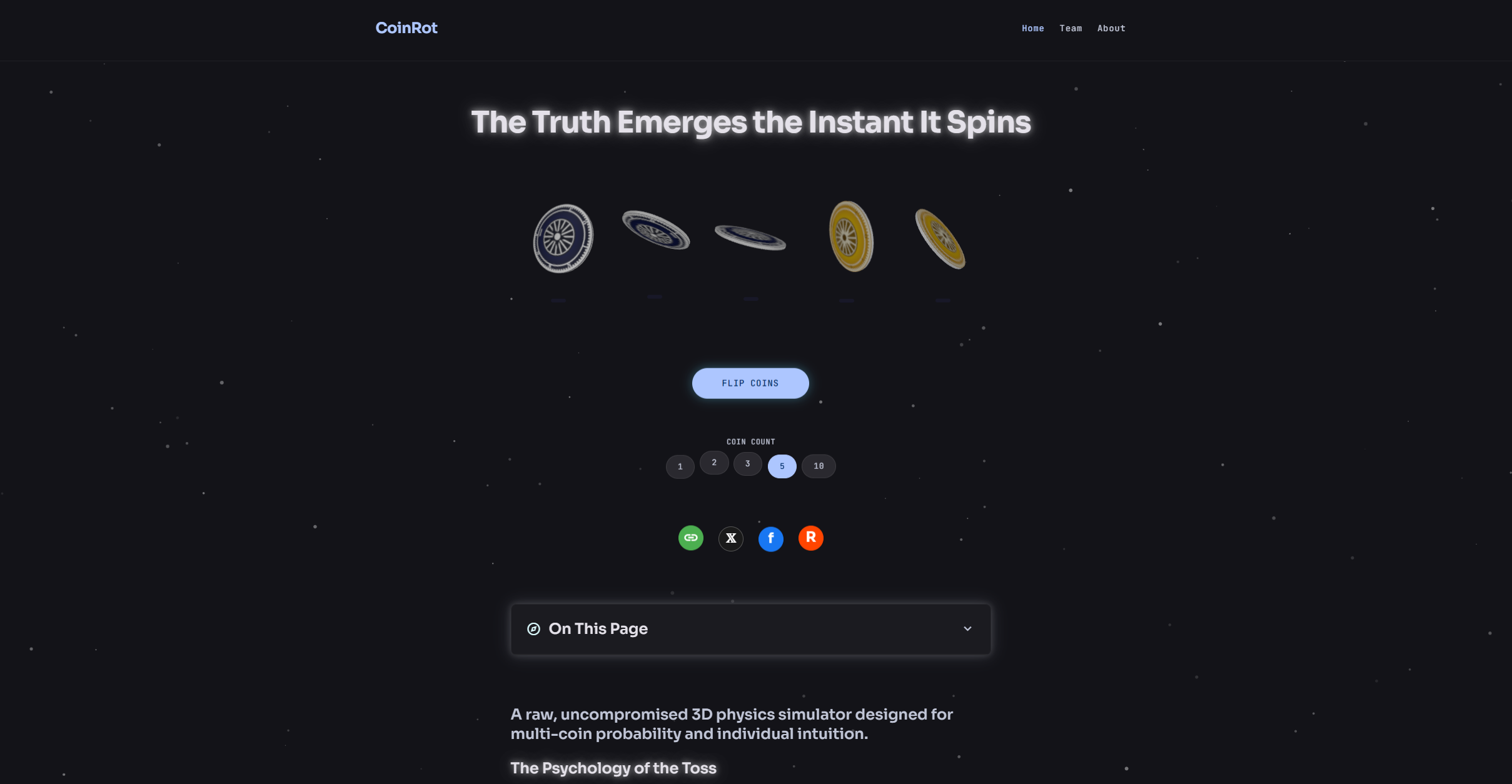
Upon visiting coinrot.com, the first thing you notice is how deliberately sparse the interface is. No ads, no pop-ups asking for your email, no cluttered dashboards. Just a single 3D coin rendered on a clean background, a row of coin count buttons (1, 2, 3, 5, 10), and a flip button. Below the flip area, however, the site presents a surprisingly philosophical take on decision-making. The copy doesn't just explain what the tool does — it delves into the psychology of choice, describing how flipping a coin reveals your subconscious preference the moment it leaves your hand. This framing immediately signals that coinrot is not merely a utility but a tool designed with intentionality. The site is built by 345tool, an independent developer collective that focuses on single-purpose, privacy-first web utilities. And it shows: the entire experience feels purpose-built rather than assembled from templates.
How the 3D Physics Engine Actually Works
The core promise of coinrot is that it uses a pure client-side 3D physics engine powered by WebGL and hardware acceleration. I tested this by flipping a single coin several dozen times, and the visual fidelity is genuinely impressive. The coin doesn't just spin in a canned animation — it wobbles, rattles against the surface, and settles with a natural momentum that feels authentic. According to the documentation, each flip translates cryptographic random variables into real-time forces: velocity, torque, and gravitational acceleration all act on the rigid body. The high-frequency wobble you see as the coin comes to rest is calculated through real-time collision detection, not pre-rendered. Importantly, all of this happens locally on your device. There is no server-side manipulation, no predictive algorithms, and no way for the site to influence the outcome. For skeptics, this is a meaningful distinction from many online coin flippers that may use simple pseudo-random number generators. The engine treats every flip as a unique physical event, which makes the 50/50 probability feel earned rather than asserted.
Multi-Coin Mode: A Lightweight Probability Laboratory
Where coinrot elevates itself beyond a simple decision-making gadget is in its multi-coin flipping capability. You can flip 1, 2, 3, 5, or 10 coins simultaneously, all interacting with each other physically. I tested the 10-coin mode multiple times, and the experience is chaotic in the best way. Coins collide mid-air, bounce off one another on the virtual surface, and settle with independent vectors. This isn't just a gimmick — it genuinely serves as a visual demonstration of probability theory. The site explicitly frames this as a bridge between psychology and statistical science, and I can see it being useful in classrooms teaching binomial distribution, the Law of Large Numbers, or basic probability. For tabletop RPG players managing complex multi-tier outcomes or gaming penalties, it also offers a more engaging alternative to rolling a handful of dice. The collision physics are handled in real-time by the engine, meaning overlapping bounces and kinetic energy transfers are calculated on the fly. It is not a simulation of randomness — it is randomness expressed through physical simulation.
Design Choices Rooted in Accessibility
One of the more thoughtful aspects of coinrot is its color palette. The coin uses a Gold front (Heads) and a Deep Blue back (Tails) — a high-contrast scheme chosen intentionally to aid users with color vision deficiencies. The site states that this design allows red-green, blue-yellow, and totally colorblind users to read the result of multiple coins in under 0.1 seconds. I tested this by flipping multiple coins and glancing at the result, and the contrast is indeed stark enough that you never have to squint or second-guess which side landed up. This is a small detail, but it reflects a broader design philosophy of universal accessibility. There are no login walls, no registration prompts, and no tracking scripts. The tool works instantly on any modern browser, and the entire experience loads within a second or two. For users accustomed to bloated web apps, the restraint feels refreshing.
Privacy, Pricing, and Practical Limitations
coinrot is completely free to use. There are no pricing tiers, no premium plans, and no hidden upsells. The site is stateless by design — your inputs and history vanish the moment you close the browser tab. No data is stored, logged, or transmitted. From a privacy perspective, this is about as good as it gets for an online tool. However, the simplicity also means the feature set is intentionally narrow. You cannot change the coin's appearance, adjust physics parameters, or save flip histories. There is no export function for results, nor any statistical aggregation beyond what you observe visually. The tool serves one function and serves it well, but if you need a full-featured probability tracking system or customizable coin designs, you will need to look elsewhere. Also worth noting: because the physics run on your local GPU, performance on very old devices may be slightly less smooth, though I tested it on a mid-range laptop and it ran flawlessly even with 10 coins.
Who Should Use coinrot and Why
I see three main audiences for this tool. First, individuals facing a tough binary decision who want a psychologically neutral proxy to reveal their own preference — the site's own framing is spot-on here. Second, educators teaching probability, statistics, or physics concepts who want a visually compelling demonstration that students can interact with directly in a browser. Third, tabletop gamers and game masters who need a fair, physical-feeling randomizer for multi-outcome scenarios. The tool is not suited for cryptographic randomness needs (it is not designed for that), nor for anyone requiring auditable records of flips. But within its intended scope, it delivers exactly what it promises: a raw, uncompromised 3D physics simulator for multi-coin probability and individual intuition. The lack of ads, tracking, or monetization makes it feel like a genuine utility rather than a lead-generation funnel. Visit coinrot at https://coinrot.com to explore it yourself.


Commentaires