
What Once Blog Actually Does
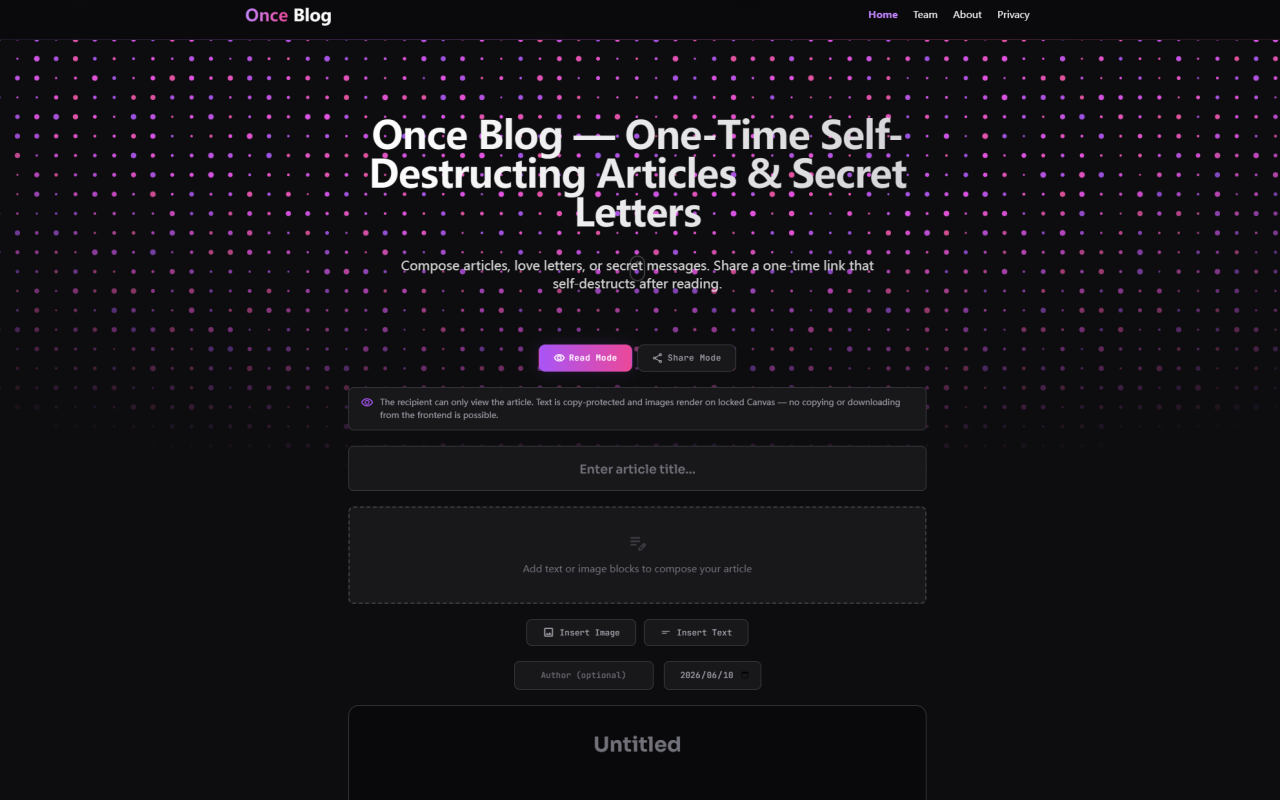
Upon visiting onceblog.com, you're greeted not by a marketing splash page but by the tool itself—a clean, minimalist article composer that looks more like a lightweight blog editor than your typical burn-after-reading utility. The tagline says it all: "Compose ephemeral articles and one-time self-destructing letters." This is a tool built for sending messages that are meant to be read once and then erased from the digital universe. The target audience is anyone who needs to share sensitive information—API tokens, corporate credentials, personal letters, or time-sensitive drafts—without leaving traces. Unlike standard text-only tools that dump raw content into a single box, Once Blog gives you a proper article editor with titles, multiple text blocks, image inserts, author signatures, and date stamps. The result renders as a styled blog page on the recipient's end, not a plaintext firehose.
First Impressions and Onboarding Flow
The first thing you notice is the absence of any sign-up prompt. There are no account creation forms, no email fields, no cookie consent popups demanding your attention. You land on the page and immediately see the composer: a title input, text and image block insertion buttons, and a live preview panel that updates as you type. Below the editor sit the controls: a password lock toggle, a max views slider, a time limit input in minutes, and the big "Generate One-Time Link" button. It took me roughly twenty seconds to write a test article, set a password, configure a 10-minute timer, and generate my first link. The entire flow is frictionless. The tool also offers a toggle between "Read Mode" and "Share Mode"—the former locks down copy and download capabilities, while the latter adds a "Copy All Text" button and per-image download controls for more collaborative scenarios.
The Security Model: How It Actually Works
Under the hood, Once Blog employs a hybrid dual-layer encryption architecture that goes beyond simple client-side scraping. When you hit publish, your content is encrypted with AES-256-CBC inside your browser before transmission. The encrypted payload then lands on the server as an opaque base64 blob. The decryption key lives exclusively in the URL's fragment anchor—the part after the # symbol—which browsers never send to the server. This means the server never holds the key to decrypt your content. If you set a password, the key is derived from your passphrase using PBKDF2-SHA256 with 100,000 iterations and a random salt, and that derived key is never stored or logged anywhere. The result is a genuine zero-knowledge system: even with full server access, an attacker sees only encrypted ciphertext with no way to decrypt it. The destruction side is equally rigorous. The moment a recipient's browser fetches the encrypted payload, the server executes an immediate unlink() on the file and deletes all associated images, all before any HTML reaches the browser. There's no recovery window, no backup, no snapshot. The URL instantly becomes a dead 404 page.
Read Mode Versus Share Mode
One of the more thoughtful design decisions in Once Blog is the separation of permission layers into two distinct modes. Read Mode (the default) serves the payload as a locked visual stream. Copy hotkeys like Ctrl+C and Cmd+C are intercepted, the right-click context menu is disabled, and images render exclusively onto isolated HTML5 Canvas nodes rather than standard tags. This makes frontend scraping and asset downloading genuinely difficult for casual attempts. Share Mode, on the other hand, is engineered for scenarios where the recipient does need to interact with the content. It appends a "Copy All Text" button at the bottom of the article and activates a sequential download pipeline beneath images, allowing recipients to save clean, metadata-purged PNG copies—while still rendering the original host URL permanently dead. During my testing, switching between the two modes and regenerating links worked instantly. The trade-off is clear: Read Mode for maximum security, Share Mode for practical collaboration. Both modes respect the same encryption and destruction guarantees.
Pricing and Real-World Limitations
Once Blog is completely free to use. There are no pricing tiers, no paid plans, and no registration walls. The parent company, 345tool, monetizes through standard non-intrusive ad placements and contextual linking, as stated in their FAQ. That said, there are practical limitations baked into the tool that are worth noting. Text content is capped at 20,000 characters across all blocks, and image uploads are limited to three files at a maximum of 5MB each, supporting PNG, JPG, WebP, and AVIF formats. The self-destruct timer maxes out at 60 minutes—there's no way to extend an article's lifespan beyond that hard limit. If you need to share content that lives longer than an hour, this simply isn't the tool for that. Additionally, the recipient must be online to view the article; there's no offline caching or download option for the rendered page. These are deliberate trade-offs to maintain the privacy and ephemeral guarantees, but they do narrow the tool's use cases to short-lived, sensitive communications.
Who Should Use Once Blog (And Who Shouldn't)
Once Blog excels in scenarios where the combination of rich formatting and guaranteed destruction matters. Journalists sharing draft articles with editors, developers transmitting API keys or database credentials, individuals writing personal letters or confessions, and professionals sending time-sensitive corporate updates will all find value here. The interface is polished enough that you can use it for genuine micro-blogging—a thought piece that lives for exactly one hour and then vanishes. Where it falls short is persistent content. If you need a permanent blog, a newsletter archive, or any form of long-term publishing, this tool is the wrong choice by design. The 60-minute shelf life and single-use destruction model make it unsuitable for evergreen content. Likewise, teams needing collaboration features like comments, version history, or multi-user editing will need to look elsewhere. Once Blog is laser-focused on a single job: sending encrypted, self-destructing, formatted articles with no accounts and no trace.
Visit Once Blog at https://onceblog.com to explore it yourself.


Commentaires