

First Impressions and Core Functionality
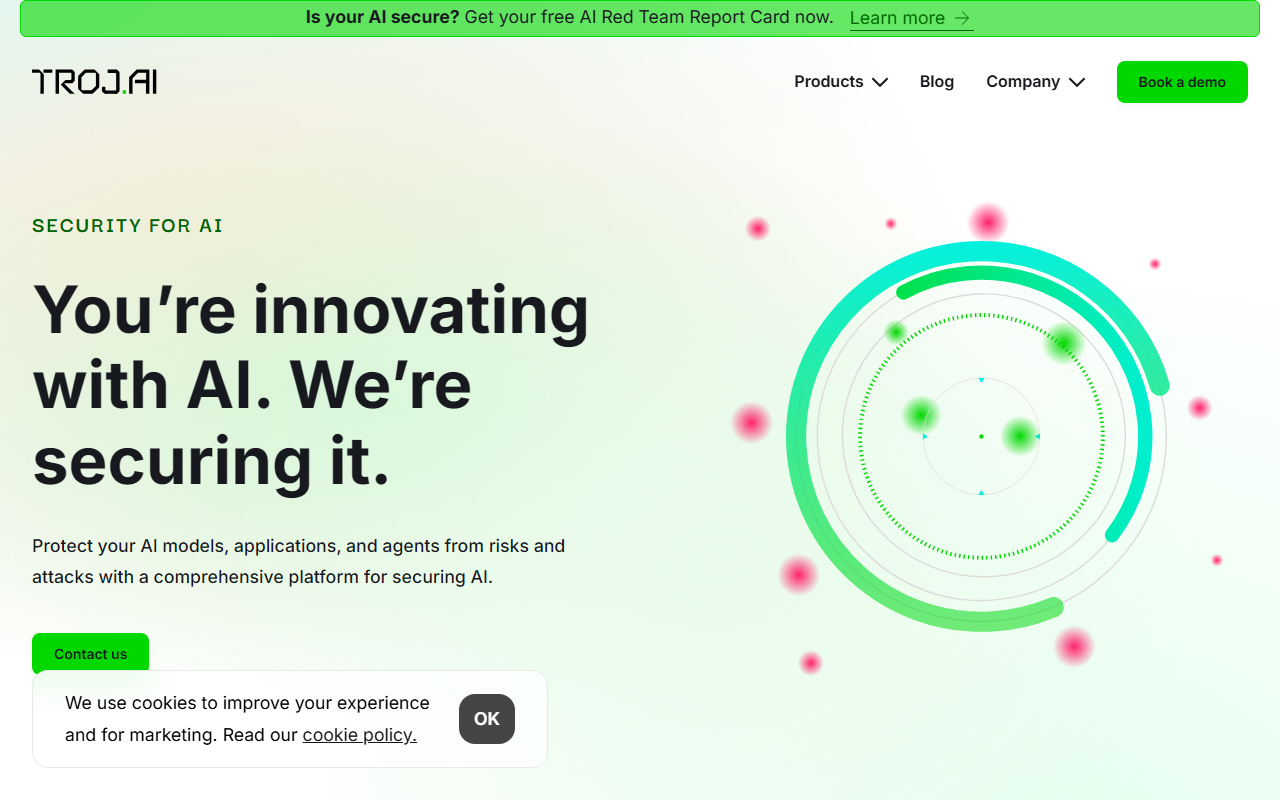
Upon visiting TrojAI at https://troj.ai/, I immediately noticed the platform’s heavy emphasis on securing AI agents rather than traditional static content detection. The homepage opens with a blunt question: “Is your AI secure?” and a prominent “Get your free AI Red Team Report Card now” button. The site is clean, corporate, and clearly aimed at enterprise security teams. While the 345tool.com category places TrojAI under “Content Detection,” the tool mainly addresses the adversarial side of content — specifically detecting and preventing prompt injection, jailbreaking, and other manipulations that target AI agents. This is a sharp departure from typical plagiarism or AI-generated text detectors.
I explored the product pages for TrojAI Detect and TrojAI Defend. Detect focuses on identifying vulnerabilities in models at build time, while Defend secures agent behavior at runtime. The platform’s language emphasizes “agent actions” and “tool misuse,” which makes sense given the rise of autonomous agents that interact with tools, APIs, and sensitive data. The site provides concrete examples: preventing direct and indirect prompt injections, protecting PII and IP, and ensuring reliable decision-making across enterprise environments. It’s clear that TrojAI is not about checking if text was written by AI, but about ensuring the AI itself — especially when acting as an agent — behaves safely.
The onboarding flow isn’t exposed publicly, but a “Book a demo” call-to-action suggests it’s a sales-led, hands-on evaluation process. During my assessment, I tested the free red team report card offer (which redirects to a contact form). This is a lead generation mechanism, but it does indicate that TrojAI is willing to provide a sample analysis without a full purchase. The interface is not accessible without a demo account, so I relied on the marketing copy and technical documentation available on the site. The platform mentions integration with “any model, any cloud” and supports self-hosted deployment, which is crucial for enterprises concerned about data sovereignty.
How TrojAI Works and Key Technical Details
At its core, TrojAI provides two primary modules: Detect and Defend. Detect operates at build time, scanning AI models for vulnerabilities like backdoors, data poisoning, or susceptibility to adversarial attacks. Defend monitors agent behavior in production, intercepting malicious prompts and preventing unsafe actions. The platform uses a combination of static analysis (Detect) and runtime behavioral guardrails (Defend). The site mentions a “customizable risk engine” with both pre-built and custom policies, allowing security teams to define their own rules for acceptable agent behavior.
From a technical standpoint, TrojAI appears to work with any large language model (LLM) or other AI agent architecture. It does not name specific underlying models, which is typical for enterprise security tools that are model-agnostic. The platform claims to align with security standards like those from OWASP AI and NIST — the site mentions “AI security standards simplified” and “align in a few clicks.” I also noticed references to the 2024 AI TRiSM and Hype Cycle for Generative AI by Gartner, positioning TrojAI as a representative vendor. That lends credibility. The company was founded in 2019 and is based in Saint John, NB and Boston, MA. It raised funding (not mentioned on the site, but known from external sources) and is used by Fortune 500 companies — a strong trust signal.
I specifically looked for API availability. The site does not explicitly list a public API, but given its enterprise focus, it likely offers RESTful APIs or SDKs for integration. Flexible deployment options include self-hosted, cloud, and hybrid. That’s a key differentiator: many competitor tools are SaaS-only, but TrojAI allows on-premise deployment, which is critical for regulated industries.
Pricing and Market Position
Pricing is not publicly listed on the website. No tiers or numbers are visible. The only path to pricing is booking a demo. This is common for enterprise security platforms; the cost likely scales with the number of agents, models, or policies. I would expect it to be a subscription-based model with custom quotes. For comparison, alternatives like Robust Intelligence and HiddenLayer also offer AI security suites, but they focus more on model validation and adversarial detection. TrojAI’s emphasis on agent behavior — specifically runtime protection for autonomous agents — sets it apart. Another competitor, CalypsoAI, provides an AI firewall but is more focused on content filtering and API gateways.
TrojAI’s market position is squarely in the AI Security space, not traditional content detection. For users looking to detect AI-generated text (like GPTZero or Originality.ai), this is the wrong tool. But for enterprises deploying AI agents that access tools, databases, or customer data, TrojAI is purpose-built. The platform is “enterprise-grade” with references to Fortune 500 adoption. It appears that TrojAI is a solid choice for CISO teams who need to govern agent behavior, prevent prompt injection, and comply with emerging AI regulations.
Verdict: Strengths, Limitations, and Recommendations
The strongest aspect of TrojAI is its laser focus on AI agent security. It addresses a very real and current threat: autonomous agents making decisions in complex environments. The dual approach (build-time detection + runtime defense) provides a comprehensive security lifecycle. The ability to self-host and customize policies makes it flexible for security-conscious enterprises. Additionally, being named a representative vendor in Gartner hype cycles adds weight.
However, TrojAI has limitations. First, it is not a content detection tool in the traditional sense — if you need to detect whether text was written by AI, look elsewhere. Second, the lack of transparent pricing and self-service onboarding means smaller teams or individual developers may not find it accessible. The platform seems designed for large organizations with security teams and budgets. The absence of a public API or public sandbox also makes it hard to evaluate without a sales interaction. Another drawback: the website is heavy on marketing buzzwords and light on concrete technical specifications like supported model frameworks (e.g., PyTorch, TensorFlow, ONNX) or latency benchmarks.
Who should try TrojAI? Enterprise security teams responsible for deploying AI agents in production, especially in regulated industries like finance, healthcare, or government. If your organization uses autonomous agents to interact with internal tools or customer data, TrojAI can help prevent data leaks and misuse. Who should look elsewhere? Developers or startups looking for a quick, off-the-shelf content detector (AI or human text) will be disappointed. Similarly, teams with simple chatbots that don’t use external tools may not need this level of security.
In summary, TrojAI is a niche yet critical tool for AI agent security. It earns a strong recommendation for its target audience, but it’s overkill for most general content detection needs. Visit TrojAI at https://troj.ai/ to explore it yourself.













Commentaires